
Mnamon
Ancient writing systems in the Mediterranean
A critical guide to electronic resources
News
-
 2026-11-17
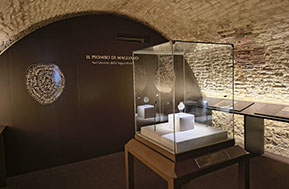
Exhibition "The Lead Plaque from Magliano: In the Labyrinth of the Etruscan Language"
Following its success last summer, the exhibition “The Magliano Lead Tablet: Into the Labyrinth of the Etruscan Language,” organized by the National Archaeological Museum of Florence in collaboration with the Municipality of Magliano in Toscana, has been extended through January 2027.
For the occasion, the Florentine museum has taken the fifth-longest Etruscan inscription—which had been donated to the museum in 1888 by the Busatti brothers, owners of the land where it was discovered six years earlier—back to its place of origin.
The Magliano Lead is a metal disc dating to the mid-5th century B.C., engraved on both sides with two long Etruscan inscriptions arranged in a spiral, which record a series of rituals dedicated to the Etruscan deities of the afterlife. Thanks to a 3D replica of the Etruscan artifact produced by the CNR Institute of Cultural Heritage Sciences, the exhibition will become a permanent feature in Magliano even after the “Piombo di Magliano” returns to Florence. In addition, starting in December, a public program dedicated to this famous Etruscan artifact and to the archaeology of the Grosseto Maremma will also begin. This program of initiatives will engage the local community through April 2027, featuring cultural activities, workshops, meetings, outdoor experiences, and opportunities to explore the area’s archaeological and landscape heritage. The initiative kicks off with two calls for proposals: the first is aimed at third-sector organizations and local associations to gather proposals and projects for cultural participation, and the second is dedicated to illustrators, who are invited to reinterpret the Piombo di Magliano through the language of illustration.
The first events are scheduled for December, featuring conferences, workshops, and guided tours: a wide-ranging program that connects the museum, the village, and the surrounding area, making culture an opportunity for connection and participation.
The initiative is sponsored by the Ministry of Culture as part of the Olivetti Plan for Culture, coordinated by the Department for the Enhancement of Cultural Heritage and supported by the Central Institute for the Economic Enhancement and Promotion of Cultural Heritage.
(Daniele Maras) -
 2026-04-03
CHiL: The Corpus of the Hittite Laws
The critical edition of CTH 291, the first series of the Hittite Laws (“If a man…”), is now available online at this address. Almost 60 years after the edition in Italian of the Corpus of Hittite Laws edited by Fiorella Imparati, a team from the University of Florence (G. Torri, L. Warbinek and A. Carnevale) presents a new digital edition of various manuscripts that are part of the corpus of the so-called Hittite Laws. The edition of the second series, CTH 292 (“If a vine…”), will soon follow.
All manuscripts are presented in transliteration, transcription and translation, accompanied by a detailed critical apparatus. The system (developed by the HFR team) also allows for an immediate display, via a glossing system, of the grammatical analysis of individual lemmas.
The project will continue over the next two years thanks to the funding from the Fritz Thyssen Stiftung (Corpus Relectum: The Hittite Laws between Past and Present - CoRel).
(Giulia Torri)